



IUI (intrauterine insemination) is a type of artificial insemination. Sperm that have been washed and concentrated are placed directly inside your uterus during ovulation. This helps healthy sperm get closer to the egg when it’s released by your ovary. It’s a common fertility treatment for couples or individuals wishing to conceive.
Advertisement
Cleveland Clinic is a non-profit academic medical center. Advertising on our site helps support our mission. We do not endorse non-Cleveland Clinic products or services. Policy
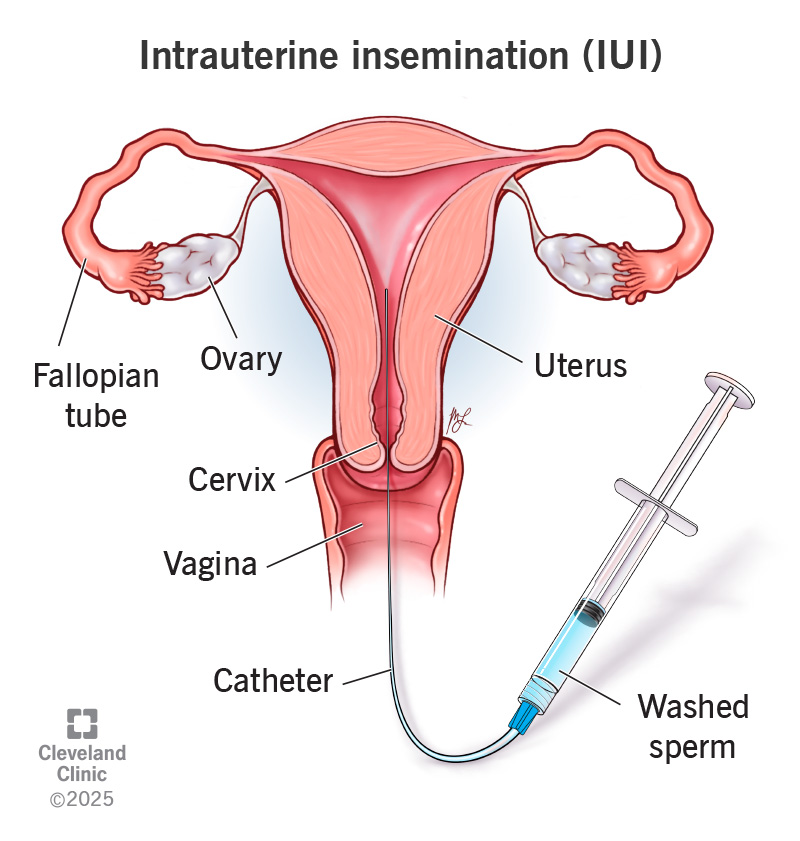
Image content: This image is available to view online.
View image online (https://my.clevelandclinic.org/-/scassets/images/org/health/articles/22456-iui-intrauterine-insemination)
Intrauterine insemination (IUI) is a fertility treatment where sperm is placed directly into your uterus.
Advertisement
Cleveland Clinic is a non-profit academic medical center. Advertising on our site helps support our mission. We do not endorse non-Cleveland Clinic products or services. Policy
During a natural conception, sperm has to travel from your vagina through your cervix, into your uterus and to your fallopian tubes. Once your ovary releases an egg, it travels to your fallopian tube. This is where the sperm and egg meet and fertilization occurs.
With IUI, sperm is placed directly into your uterus with a catheter (thin tube). This puts it closer to your fallopian tubes. IUI makes it easier for the sperm to reach an egg because it cuts down on the time and distance it has to travel. This increases your chance of becoming pregnant.
Healthcare providers often try IUI before other, more invasive and expensive fertility treatments. IUIs can be performed with your partner’s sperm or with donor sperm. You may need to take fertility drugs to make sure you ovulate.
People choose IUI if they have infertility and haven’t been able to get pregnant. It’s also an option when these conditions are present:
Advertisement
The timeline for the IUI procedure is about four weeks from beginning to end. It’s about the same length as a typical menstrual cycle.
Before starting IUI treatment, you’ll need a thorough medical exam and fertility tests. Your partner will be examined and tested, as well. This could include:
It’s a good idea to start taking prenatal vitamins about three months before you begin fertility treatment.
Every treatment plan and healthcare provider may have a slightly different process. IUI treatment typically includes the following:
Advertisement
Talk to your healthcare provider to get the best understanding of the IUI process and what to expect.
There are some mild symptoms that you can experience after IUI, like:
Most people will return to normal activities right away. You should avoid anything that makes you feel uncomfortable after IUI, but there usually aren’t any restrictions.
Some people experience mild side effects from fertility medications. The most common side effects after insemination are cramping and spotting.
IUI can be mentally and physically difficult. Talk with your healthcare provider if you’re feeling disappointed or overwhelmed so they can help you through the process.
Advertisement
IUI is low risk compared to other, more invasive fertility treatments like IVF. Some of the risks of IUI are:
The effectiveness of IUI is mostly dependent on the cause of infertility and the age of the mother. As you age, you have fewer eggs, and the quality of those eggs decreases. Success rates for IUI tend to be higher in people under age 38.
Most pregnancies achieved through IUI occur within the first three to four cycles. If pregnancy hasn’t occurred after this time frame, you may want to discuss further testing or alternative treatments, like IVF. Because there can be so many factors, it’s hard to say how long it may take for you or whether it’ll be successful. It’s best to talk with your healthcare provider about your unique circumstances.
Most healthcare providers recommend three cycles of IUI before moving on to IVF. In some cases (for example, if your partner has a very low sperm count or if you’re over 38 years old), going straight to IVF treatment and skipping IUI may be a better option for you. Other times, your provider may recommend up to six IUI cycles before moving to IVF.
Advertisement
It’s best to have these types of discussions with your healthcare team because they have the best understanding of your situation.
If you’re taking fertility medications for IUI, you should contact your healthcare provider if any of the following happen:
Most people will try IUI before IVF because it’s more affordable and less invasive. In some cases, your healthcare provider will decide IUI won’t work for you and recommend IVF. This can be due to age or the underlying reason for infertility. One treatment isn’t better than the other, but one may give you a higher chance of conceiving.
You aren’t alone in your pregnancy journey. Many people struggle with infertility, spending month after month waiting for a positive test. Try not to lose hope. There are many advances in technology that help people achieve pregnancy. IUI may be one of those options.
You probably have lots of questions about the process, the timing and your chances of getting pregnant. Don’t be afraid to ask your healthcare team all these questions. Your healthcare provider is there to work with you and determine the right fertility treatment to help you grow your family.



Sign up for our Health Essentials emails for expert guidance on nutrition, fitness, sleep, skin care and more.
Learn more about the Health Library and our editorial process.
Cleveland Clinic’s health articles are based on evidence-backed information and review by medical professionals to ensure accuracy, reliability and up-to-date clinical standards.
Cleveland Clinic’s health articles are based on evidence-backed information and review by medical professionals to ensure accuracy, reliability and up-to-date clinical standards.
Infertility can change your plans. Cleveland Clinic’s experts can work with you to get to the bottom of male infertility and create a customized treatment plan.
